
 English
 Español
 عربى
عربى

Content
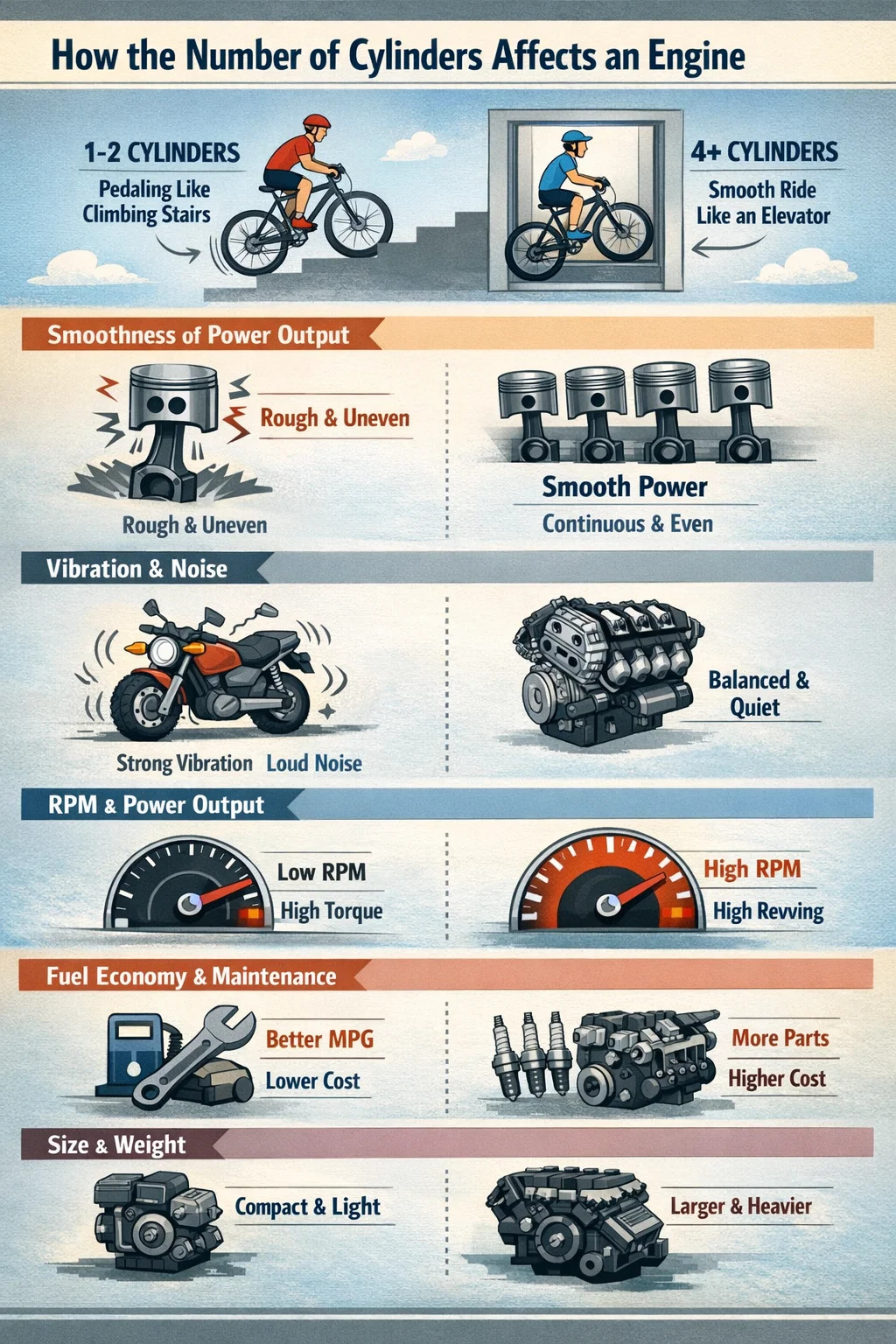
The number of cylinders directly determines the "character" of an engine. We can imagine the cylinders as the legs pedaling a bicycle: the more legs there are, the more continuous the pedaling motion, and the smoother and faster the ride.
Here's how the number of cylinders specifically affects the engine:
1. Smoothness of Power Output
The more cylinders, the smoother the power delivery.
Low cylinder count (1-2 cylinders): It's like climbing stairs; you can feel a distinct "pedaling sensation." This type of engine has good power at low RPMs, but the power output has a noticeable pulsating feel and is not very continuous.
High cylinder count (4 cylinders and above): It's more like riding an elevator; the power output is very smooth. Because multiple cylinders are "working" in rotation, there are cylinders producing thrust almost every instant, and you hardly feel any interruption in power.
2. Vibration and Noise Control
Balance: The more cylinders there are, the easier it is to achieve physical balance for the reciprocating parts (such as pistons). For example, a four-cylinder engine can cancel out vibrations by having pairs of pistons moving up and down.
Refinement: Engines with fewer cylinders have a larger impact with each combustion, and the vibration is more direct (which is why some large single-cylinder motorcycles can cause hand numbness after riding for a long time). With more cylinders, the force of each combustion is smaller, the sound is more refined, and it's quieter at idle.
3. RPM and Power Output
High RPM potential: If the total displacement of the engine is the same, more cylinders mean that the parts in each cylinder (such as the piston) are smaller and lighter. Lightweight parts are easier to move up and down quickly, allowing the engine to reach very high RPMs.
Low-speed torque: Conversely, single-cylinder or twin-cylinder engines, although not high-revving, have larger cylinders and longer strokes, giving them more "oomph" at the start, providing better low-speed torque, suitable for heavy loads or off-road driving.
4. Fuel Economy and Maintenance
Fuel efficiency and wear: Generally, fewer cylinders mean less internal friction loss in the engine, and usually better fuel economy. Cost Considerations: The more cylinders an engine has, the more internal parts (such as spark plugs, valves, connecting rods, etc.) it requires. This means higher production costs, and consequently, higher maintenance and repair costs.
5. Size and Weight
Compactness: Engines with fewer cylinders are usually very light and compact, making them suitable for installation in small motorcycles or compact cars.
Space Occupancy: While six-cylinder or eight-cylinder engines offer powerful performance, they occupy a significant amount of space in the engine compartment and increase the overall weight of the vehicle, which in turn affects the vehicle's handling and agility.