
 English
 Español
 عربى
عربى

Content
- 1 How Long Does a Cylinder Rebuild Actually Take?
- 2 What Counts as a Motorcycle Cylinder Rebuild?
- 3 Time Breakdown by Motorcycle Engine Type
- 4 Step-by-Step: What Happens During a Motorcycle Cylinder Rebuild
- 4.1 Phase 1: Diagnosis and Inspection Before Teardown
- 4.2 Phase 2: Engine Removal or Access
- 4.3 Phase 3: Cylinder Head Removal and Teardown
- 4.4 Phase 4: Cylinder and Piston Removal
- 4.5 Phase 5: Measurement and Assessment
- 4.6 Phase 6: Machine Shop Work (If Required)
- 4.7 Phase 7: Cylinder Head Work
- 4.8 Phase 8: Parts Sourcing and Lead Times
- 4.9 Phase 9: Reassembly
- 4.10 Phase 10: Break-In and Retorque
- 5 Factors That Make a Cylinder Rebuild Take Longer
- 6 How Cylinder Condition Affects Total Rebuild Time
- 7 DIY vs. Professional Shop: Time Comparison
- 8 Tools and Preparation That Reduce Rebuild Time
- 9 Rebuild Intervals: When Does a Motorcycle Cylinder Actually Need Rebuilding?
- 10 Cost Considerations That Affect How You Plan the Rebuild
- 11 Realistic Timelines for Specific Motorcycle Examples
- 12 How to Shorten the Total Rebuild Timeline
How Long Does a Cylinder Rebuild Actually Take?
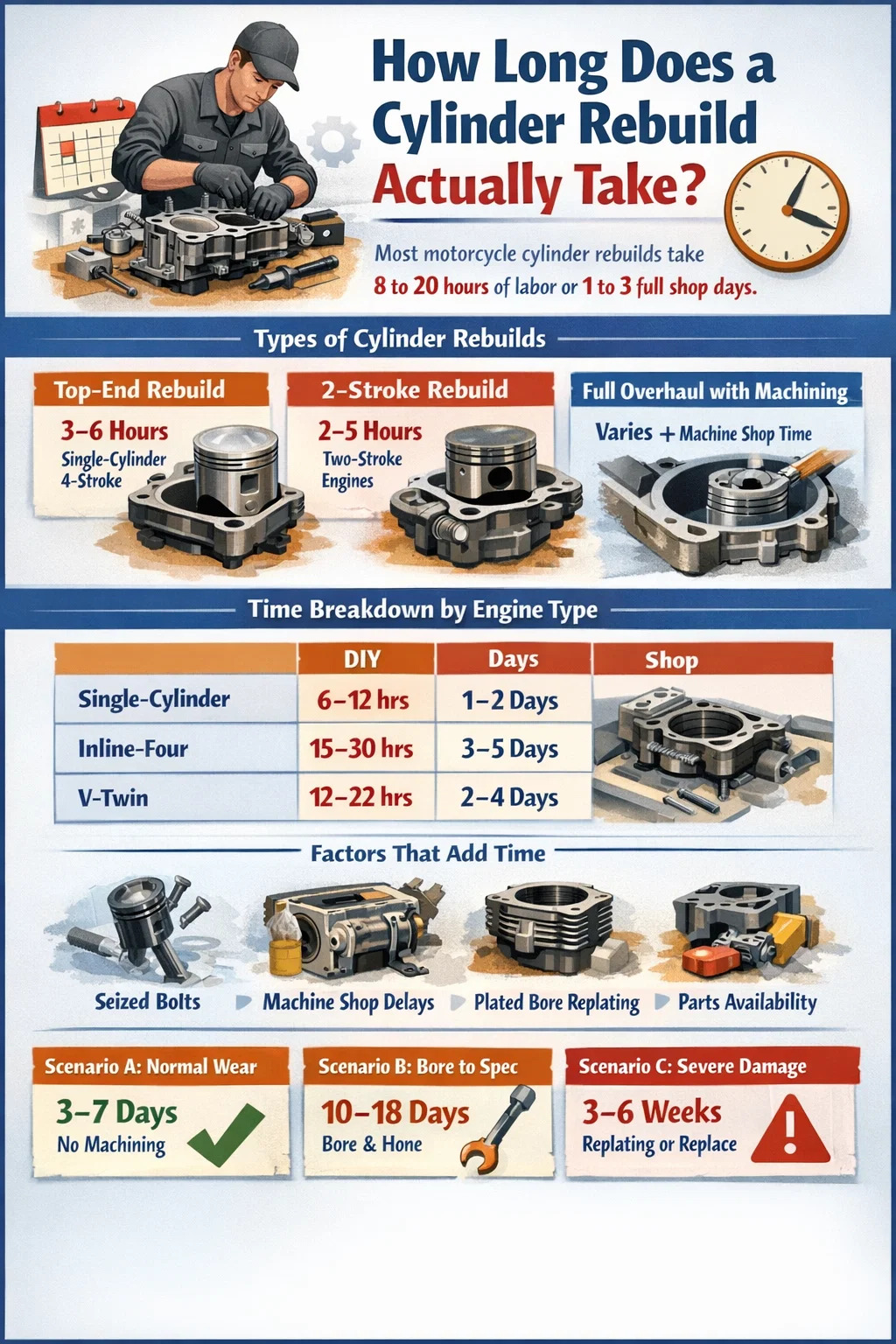
For most motorcycle cylinder rebuilds, you should plan for 8 to 20 hours of labor if you are doing the work yourself, or roughly 1 to 3 full shop days if the job is handed to a professional mechanic. That range is wide on purpose — the actual time depends heavily on the engine type, the condition of the cylinder, whether machine shop work is needed, and parts availability.
A simple single-cylinder motorcycle engine with minimal wear and readily available parts can realistically be back together in a weekend. A multi-cylinder sportbike with damaged bores, warped surfaces, and back-ordered OEM pistons could stretch the job to two or three weeks once you factor in waiting on the machine shop and parts shipping.
Before diving into specifics, understand that the physical wrenching time and the total calendar time are two very different numbers. Mechanic hours measure hands-on work. Calendar time includes machining queues, parts lead times, and drying time for gasket sealants. Both matter when you are planning how long your bike will be out of commission.
What Counts as a Motorcycle Cylinder Rebuild?
The term "cylinder rebuild" gets used loosely, and the scope of work dramatically changes the time estimate. Before you can estimate how long a job will take, you need to define exactly what is being done.
Top-End Rebuild
This is the most common type. A top-end rebuild on a motorcycle cylinder involves removing the cylinder head, inspecting and replacing the piston and rings, checking the cylinder bore for wear, and reassembling everything with new gaskets and seals. On a single-cylinder four-stroke engine like a Honda CRF450 or Kawasaki KLX300, an experienced mechanic can complete a top-end in 3 to 6 hours once all parts are on the bench.
Two-Stroke Cylinder Rebuild
Two-stroke motorcycle cylinders — common in motocross bikes, vintage machines, and smaller displacement street bikes — are structurally simpler but often require more precise work around the ports and plating. Rebuilding a two-stroke top end typically takes 2 to 5 hours for the disassembly and assembly work. However, if the Nikasil or chrome plating is worn, the cylinder needs to be sent out for replating or replaced entirely, adding days or weeks to the timeline.
Full Cylinder Overhaul Including Machining
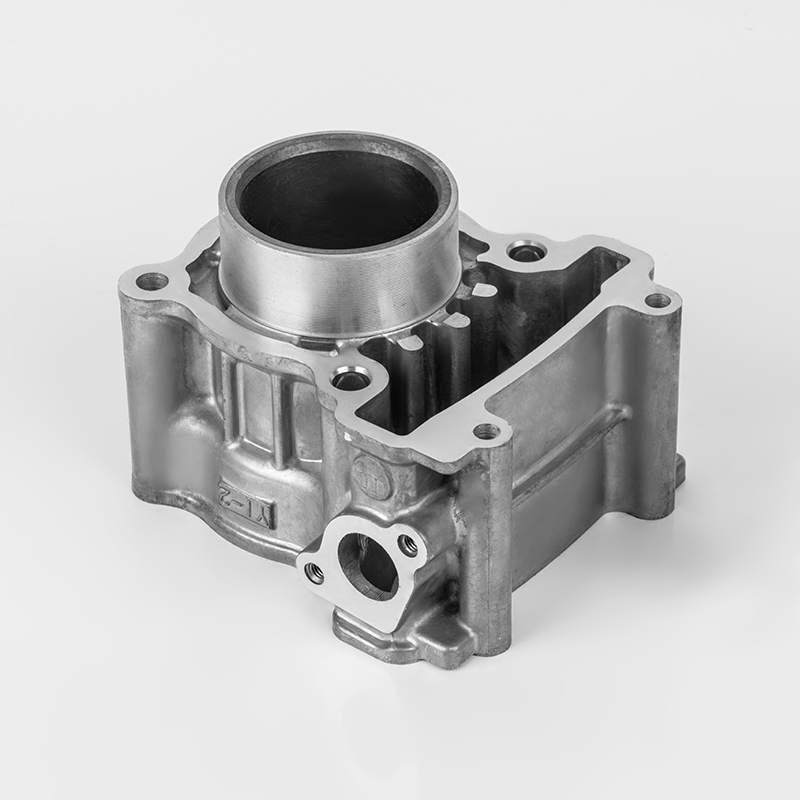
When a bore is out of round, scored, or beyond the service limit, machine shop work is required. This includes boring the cylinder to an oversize diameter and honing the walls to the correct surface finish. Most machine shops turn around a single motorcycle cylinder bore job in 2 to 5 business days, though busy shops or uncommon cylinder dimensions can push that to 7 to 10 days. Add that wait time on top of your disassembly and reassembly hours.
Time Breakdown by Motorcycle Engine Type
Engine configuration is one of the biggest factors in total rebuild time. More cylinders means more parts, more gaskets, more torque sequences, and more potential complications.
| Engine Type | DIY Labor Hours | Professional Shop Time | Calendar Time (with machining) |
|---|---|---|---|
| Single-cylinder 4-stroke | 6–12 hrs | 1–2 days | 3–10 days |
| Single-cylinder 2-stroke | 3–8 hrs | Half day–1 day | 2–14 days (replating variable) |
| Parallel twin | 10–18 hrs | 2–3 days | 5–14 days |
| Inline-four | 15–30 hrs | 3–5 days | 10–21 days |
| V-twin (Harley-style) | 12–22 hrs | 2–4 days | 7–18 days |
These figures assume a standard top-end rebuild with new pistons, rings, gaskets, and valve seals where applicable. They do not account for seized fasteners, damaged threads, stripped head bolts, or other complications that can easily add 2 to 6 hours to any job.
Step-by-Step: What Happens During a Motorcycle Cylinder Rebuild
Understanding each phase of the process helps you estimate time more accurately and avoid surprises during the job. Here is a realistic walkthrough of what a typical motorcycle cylinder rebuild involves.
Phase 1: Diagnosis and Inspection Before Teardown
Before a single bolt comes off, a compression test and leak-down test will reveal how far the cylinder has deteriorated. A compression reading below 120 psi on a typical 250cc–500cc four-stroke suggests piston ring wear. A leak-down test showing more than 15–20% leakage points toward rings, valves, or both. This diagnostic phase takes 30 to 60 minutes and saves hours of guesswork later.
Phase 2: Engine Removal or Access
Some motorcycles allow top-end access without removing the engine from the frame. Many single-cylinder enduro and trail bikes, for example, let you pull the cylinder head and jug while the engine stays mounted. Others — particularly inline-four sportbikes and some V-twins — require a full engine pull before you can access the cylinder properly. Engine removal alone on a CBR600RR or similar machine takes 2 to 4 hours on its own.
Phase 3: Cylinder Head Removal and Teardown
Removing the cylinder head requires draining coolant on liquid-cooled engines, disconnecting cam chain tensioners, pulling cam sprockets, and loosening head bolts in the correct sequence. A single-cylinder head can come off in 45 to 90 minutes. A four-cylinder head with dual overhead cams and 20 or more head bolts will take 2 to 3 hours.
Phase 4: Cylinder and Piston Removal
Once the head is off, the cylinder jug lifts away from the crankcase. The piston pin is driven out, and the piston is separated from the connecting rod. This part of the job usually takes 30 to 60 minutes per cylinder. Care must be taken to protect the crankcase opening from debris while the motorcycle cylinder is off the engine.
Phase 5: Measurement and Assessment
With the cylinder bare, bore diameter is measured at multiple points using a bore gauge or telescoping gauge and micrometer. Taper and out-of-round readings determine whether a simple hone will restore the surface or whether a full bore job is needed. Most manufacturers specify a service limit of 0.05 to 0.10mm of wear before boring is required. This measurement phase takes 30 to 45 minutes and dictates everything that follows.
Phase 6: Machine Shop Work (If Required)
If the bore needs machining, the cylinder is dropped at a machine shop. Standard oversize increments are typically 0.25mm, 0.50mm, and 1.00mm over stock. The machine shop bores the cylinder to the new diameter and hones it to achieve the correct crosshatch pattern for ring seating. A simple bore-and-hone job at a competent shop costs $60 to $150 for a single motorcycle cylinder and is usually ready in 2 to 5 business days. During this waiting period, you can clean parts, source new pistons, and prepare the head for reassembly.
Phase 7: Cylinder Head Work
While the cylinder is away or on the bench, the head gets attention. Valve clearances are checked, valve seats are inspected, and the head surface is checked for warping with a straightedge and feeler gauge. A warped head surface of more than 0.05mm typically needs resurfacing. If valves are being replaced or lapped, add another 2 to 4 hours to the head work portion of the job.
Phase 8: Parts Sourcing and Lead Times
Parts availability is often the single biggest delay in a motorcycle cylinder rebuild. OEM pistons for current production models are usually available within 3 to 7 business days from a dealer. Aftermarket options from brands like Wiseco, JE Pistons, or Vertex are often in stock and can ship same-day. For older or discontinued models, parts can take 2 to 6 weeks to source, especially from overseas suppliers. Ordering parts before teardown — once you have confirmed what the bike needs — cuts calendar time significantly.
Phase 9: Reassembly
Reassembly generally takes 60 to 80 percent of the disassembly time — but demands more care. Ring gaps must be checked and staggered correctly. Piston orientation must match the directional markings on the crown. Torque sequences for head bolts must follow the manufacturer's specification exactly, typically working in a spiral pattern from the center outward in two or three stages. On an aluminum head, over-torquing by even 10 percent can cause warping or stripped threads.
Phase 10: Break-In and Retorque
After reassembly, a newly rebuilt motorcycle cylinder needs a proper break-in period. Most manufacturers recommend 500 to 1,000 miles of varied load riding, avoiding sustained high RPM during the first few heat cycles. Many experienced builders also retorque head bolts after the first heat cycle — once the engine has reached operating temperature and cooled back down — to compensate for gasket compression and thermal expansion settling. This break-in phase is not wrenching time, but it is part of the full rebuild process.
Factors That Make a Cylinder Rebuild Take Longer
Several variables consistently push rebuild time beyond the baseline estimate. Being aware of them in advance lets you plan accordingly.
- Seized or corroded fasteners: Head bolts that have not been removed in years often seize in aluminum threads. Extraction can take hours, and in worst cases, a helicoil insert must be installed after drilling out a broken bolt. Budget an extra 2 to 5 hours if the engine is old or was not maintained with anti-seize compound.
- Scored cylinder walls: Deep vertical scoring from a spun bearing or dropped valve requires boring well beyond standard oversize increments, or sourcing a replacement cylinder entirely. This can add 1 to 2 weeks to the project.
- Nikasil or plated bore damage: Many modern motorcycle cylinders use a hard-plated bore rather than a cast-iron liner. These cannot be conventionally bored. They must be replated, sleeved with a cast-iron insert, or replaced. Replating services typically take 2 to 4 weeks and cost $150 to $400.
- Hidden damage discovered mid-rebuild: A bent connecting rod, worn big-end bearing, or crankshaft damage found after the top end is apart will expand the scope from a cylinder rebuild into a full engine rebuild. This can multiply both time and cost several times over.
- Unavailable OEM parts: Discontinued models where original pistons and gaskets are no longer manufactured require custom fabrication or aftermarket substitution research. This sourcing process alone can take days.
- First-time DIY builder: A first-time rebuilder following a service manual carefully will typically take 2 to 3 times longer than an experienced mechanic on the same job. That is not a criticism — it is simply the reality of learning while working. Factor this honestly into your timeline.
How Cylinder Condition Affects Total Rebuild Time
The physical state of the motorcycle cylinder when you open it up is the single biggest variable in the entire timeline. Three scenarios cover most situations.
Scenario A: Normal Wear, No Machining Required
Bore is within spec. Walls show minor crosshatch wear but no scoring. A light hone to restore the surface finish and new rings, piston, and gaskets are all that is needed. This is the quickest outcome. Total calendar time: 3 to 7 days, mostly waiting on parts.
Scenario B: Bore Out of Spec, Standard Machine Work Needed
Measurements show the bore has worn beyond the service limit. A bore-and-hone job is required, along with an oversize piston. The cylinder spends 3 to 7 days at the machine shop. Total calendar time: 10 to 18 days in most cases.
Scenario C: Severe Damage, Replating or Replacement Required
Deep scoring, spun bearing damage, or plated bore failure. Replating services, cylinder replacement sourcing, or sleeve installation is required. Total calendar time: 3 to 6 weeks is realistic. This scenario is most common with two-stroke motorcycle cylinders running without sufficient premix oil or with a failed powervalve.
DIY vs. Professional Shop: Time Comparison
Choosing between a DIY rebuild and taking the bike to a shop changes not just the cost but also the timeline and the type of waiting involved.
When you do a motorcycle cylinder rebuild yourself, you are in control of the schedule. You can work evenings and weekends, order parts proactively, and move quickly once the machine shop returns the cylinder. The downside is that every unknown adds time because you are learning as you go, and errors mean disassembling again. A stripped head bolt on a DIY job might add a full weekend to the project.
A professional motorcycle shop completes the hands-on work faster — often in a quarter of the time an intermediate DIYer takes. But shops have queues. During peak riding season, many independent shops are booked 2 to 4 weeks out just to get your bike on a lift. A job that takes a tech 8 hours to complete might sit 3 weeks before those 8 hours begin.
If calendar time is your primary concern, DIY with pre-ordered parts often beats the shop, especially for straightforward single-cylinder rebuilds. If technical accuracy or warranty concerns matter more, the shop is worth the wait.
Tools and Preparation That Reduce Rebuild Time
Mechanics who rebuild motorcycle cylinders regularly finish faster not just because of experience, but because of preparation. The right tools and setup reduce fumbling, mistakes, and repeat work.
- Torque wrench: Essential for head bolts. Using a click-style torque wrench to the manufacturer's specification prevents over-torque damage and retorque delays.
- Ring compressor: Speeds up piston installation from a 20-minute struggle to a 3-minute operation. A cheap compressor that does not fit well costs more time than it saves.
- Bore gauge and micrometer set: Accurate measurement prevents sending the cylinder to the machine shop twice. Renting these tools from an auto parts store costs nothing and saves days.
- Valve spring compressor: If valves are being replaced or lapped, a proper valve spring compressor eliminates the risk of dropped collets and lost components in the engine bay.
- Parts washer or ultrasonic cleaner: Clean parts before measuring and before reassembly. Dirt and old gasket material cause misleading measurements and sealing failures.
- OEM service manual: Not just helpful — essential. Torque specs, clearance limits, and assembly sequences in the OEM manual are the most reliable data source for any specific motorcycle cylinder rebuild. Third-party guides and forum posts frequently contain errors.
Spending 2 hours preparing your workspace, gathering tools, and reading through the relevant sections of the service manual before starting the job consistently saves more time than those 2 hours cost.
Rebuild Intervals: When Does a Motorcycle Cylinder Actually Need Rebuilding?
Knowing when a rebuild is due helps you plan ahead rather than react to a blown engine. Rebuild intervals vary significantly by use case.
| Motorcycle Type / Use | Typical Top-End Interval | Notes |
|---|---|---|
| MX / racing 2-stroke (250cc) | Every 15–30 hours | Piston and rings only; cylinder checked each time |
| MX / racing 4-stroke (450cc) | Every 40–80 hours | Varies significantly by brand and rider weight/intensity |
| Trail / enduro 4-stroke | Every 100–200 hours | Less stress than motocross; longer intervals realistic |
| Street motorcycle (commuter) | Every 40,000–80,000 km | If oil is changed regularly; many go further |
| High-performance sportbike | Every 30,000–50,000 km | Track use shortens intervals considerably |
Rather than guessing, pull the head and measure. A compression test dropping more than 10–15% from the manufacturer's specification, or a leak-down test showing more than 20% leakage, is a reliable signal that the motorcycle cylinder needs attention before a complete failure occurs.
Cost Considerations That Affect How You Plan the Rebuild
Cost and time are interconnected in a motorcycle cylinder rebuild. Higher budgets often buy faster turnaround — overnight parts shipping, priority machine shop service, or paying a professional shop to handle it all.
A basic DIY top-end kit for a common single-cylinder motorcycle — piston, rings, wrist pin, circlips, and full gasket set — typically costs $80 to $250 depending on the brand and whether you choose OEM or aftermarket. Add bore-and-hone work and the total parts and machining cost reaches $200 to $450. Professional labor on top of that at $90 to $150 per hour, with 5 to 10 billed hours, brings a full shop rebuild to $650 to $1,800 for a single-cylinder engine.
For inline-four sportbikes, complete professional cylinder rebuilds with machining can reach $2,500 to $5,000 once parts, labor, and machine work are all tallied. This is the range where riders often weigh whether a rebuild makes financial sense versus finding a low-mileage used engine.
Budgeting an additional 20 to 30 percent beyond your initial parts estimate is a reliable rule of thumb. Unexpected items — a warped head, a seized exhaust stud, a worn cam chain — are discovered after teardown, not before.
Realistic Timelines for Specific Motorcycle Examples
Abstract estimates are useful, but specific examples communicate the reality more clearly. Here is how the timeline actually plays out on three common motorcycle cylinder rebuild scenarios.
Honda CRF450R Motocross Bike — Regular Maintenance Rebuild
The CRF450R is designed for frequent top-end service. An experienced rider with tools on hand and parts already ordered can complete this motorcycle cylinder rebuild in one day. Disassembly takes 2 to 3 hours, inspection and measurement 30 minutes, new piston and rings go in during the afternoon, and the bike is back together by evening. If parts need to be ordered, add 3 to 5 business days for shipping. No machining required on a timely rebuild.
Kawasaki Ninja 650 — Worn Bore from Neglected Maintenance
A parallel twin with bores measured at 0.08mm out of round after 55,000 km of infrequent oil changes. Both cylinders need boring to 0.25mm oversize. Engine removal takes half a day. Cylinders go to the machine shop for 4 to 6 business days. Oversize pistons are sourced from an aftermarket supplier in 5 days. Reassembly takes a full day. Total calendar time: approximately 12 to 16 days.
Yamaha YZ250 Two-Stroke — Scored Bore from Oil Starvation
Deep vertical scoring visible to the naked eye. The Nikasil-plated bore cannot be conventionally machined. The cylinder is sent to a replating specialist. Replating turnaround: 3 weeks. New OEM piston available in stock. Disassembly and reassembly total 4 to 6 hours of hands-on work. Total calendar time: approximately 25 to 30 days, almost entirely determined by the replating queue.
How to Shorten the Total Rebuild Timeline
If getting the motorcycle back on the road quickly is a priority, there are legitimate strategies that compress the total calendar time without cutting corners on quality.
- Order parts before teardown. Once a compression test or leak-down test confirms what is needed, order parts immediately. By the time the engine is disassembled and measured, parts may already be in transit.
- Call the machine shop before dropping off the cylinder. Ask about current wait times and whether priority scheduling is available. Some shops can turn around a motorcycle cylinder bore-and-hone in 24 hours for a modest upcharge.
- Keep the rest of the bike accessible while waiting. While the cylinder is at the machine shop, use the time to clean the frame, replace consumables, inspect the chain and sprockets, and service the air filter. The rebuild downtime becomes productive maintenance time.
- Consider a pre-built replacement cylinder. For common motorcycle engines, complete remanufactured cylinders are available from suppliers like Cylinder Works or ProX. These eliminate machining wait time entirely — the replacement cylinder arrives ready to install with a new bore and sometimes an included piston kit.
- Have a service manual open before starting. Stopping mid-teardown to search for torque specs or assembly sequence costs 30 to 90 minutes per interruption. Reading through the relevant sections in advance avoids this entirely.