
 English
 Español
 عربى
عربى

Content
- 1 What a Dead Cylinder Actually Means
- 2 The Most Obvious Symptoms of a Dead Motorcycle Cylinder
- 3 Step-by-Step Diagnostic Tests to Confirm a Dead Cylinder
- 4 Common Root Causes of a Dead Motorcycle Cylinder
- 5 How the Number of Cylinders Affects the Symptoms You'll Notice
- 6 Is It Safe to Ride with a Dead Cylinder?
- 7 Preventive Measures to Avoid a Dead Cylinder
- 8 When to Take It to a Professional
What a Dead Cylinder Actually Means
A dead cylinder is one that is not firing — meaning no combustion is taking place inside that chamber during the engine's normal cycle. On a motorcycle, this is a serious issue because most bikes run on two, three, or four cylinders, and losing even one cuts your effective power output dramatically. On a parallel-twin, you're immediately down to 50% capacity. On a four-cylinder sportbike, you lose 25% of your power and the engine will run with a very rough, uneven character that you'll feel through the whole chassis.
The most direct answer: if your motorcycle is running rough, has noticeably reduced power, smells like unburned fuel, or misfires at idle and under load, there is a strong chance one of your cylinders has stopped firing. This article walks you through every method to confirm it, what causes it, and how to resolve it.
The Most Obvious Symptoms of a Dead Motorcycle Cylinder
Before you pull out any tools, your senses will usually give you the first clues. Riders who know their bike well will often detect a problem within the first few minutes of starting the engine. Here are the symptoms that point most directly to a cylinder that has stopped working.
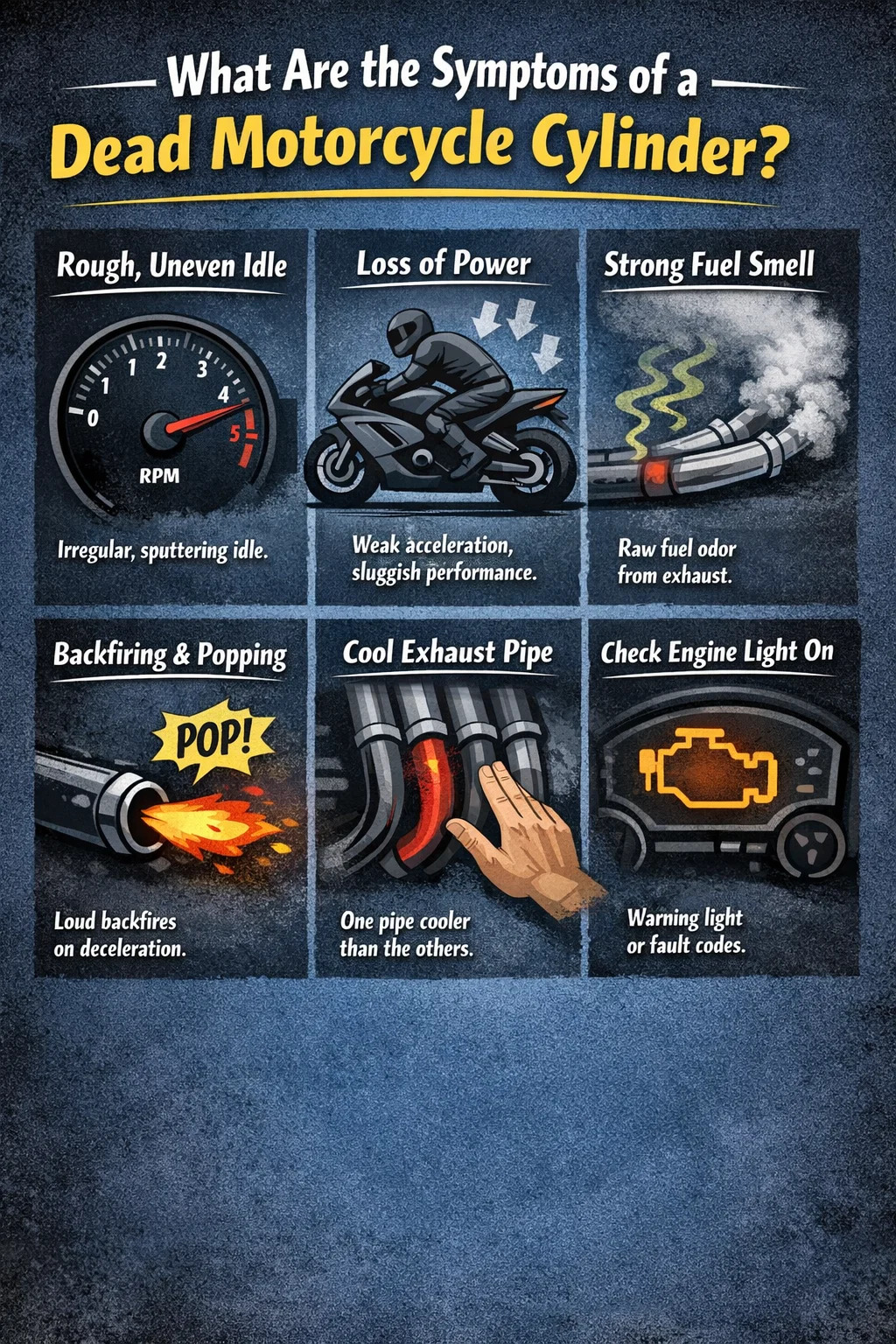
Rough, Uneven Idle
A healthy multi-cylinder engine idles with a consistent rhythm. When one cylinder drops out, the engine develops a loping, uneven beat. On a four-cylinder motorcycle, this sounds like a fluttering or pulsing idle rather than the smooth purr you'd normally expect. On a twin, the bike may shake more than usual and the exhaust note will sound distinctly off — more of a single-cylinder chug than the characteristic twin beat.
Significant Loss of Power
If your bike suddenly feels sluggish, struggles to accelerate to highway speeds, or bogs down under load, a non-firing cylinder is a top suspect. A 600cc inline-four producing around 110 horsepower on all four cylinders will feel noticeably weaker when running on three. You may still be able to ride, but the throttle response will feel flat and the top-end pull will be gone.
Strong Smell of Raw Fuel from the Exhaust
When a cylinder isn't firing, the fuel-air mixture is being pushed through the combustion chamber and out through the exhaust without being burned. This produces a very noticeable raw fuel smell from the exhaust pipe. In some cases, you may even see a small amount of black smoke or notice fuel residue around the exhaust outlet of the affected cylinder on a multi-exhaust setup.
Backfiring or Popping
Unburned fuel entering the exhaust system can ignite downstream, causing backfires or popping sounds, particularly on deceleration. While some popping on deceleration is normal on lean-mapped bikes, consistent popping combined with the other symptoms here is a strong indicator of a cylinder problem.
One Exhaust Pipe Noticeably Cooler Than the Others
This is one of the most reliable physical checks you can do on a multi-exhaust motorcycle. After running the engine for a few minutes, carefully — without touching — hold your hand near each exhaust header. On a working cylinder, the pipe will be too hot to get close to. A dead cylinder's exhaust pipe will be significantly cooler, sometimes barely warm, because no combustion is generating heat. On bikes with a 4-into-1 exhaust system, this test works best at the individual header pipes close to the engine.
Check Engine Light or Fault Codes
Modern fuel-injected motorcycles with onboard diagnostics will often throw a misfire code or a cylinder-specific fault when a cylinder stops contributing to combustion. If your dashboard warning light is on, connect a diagnostic tool or use the bike's self-diagnostic mode (available on many Yamaha, Honda, Kawasaki, and BMW models) to read the stored codes before doing anything else.
Step-by-Step Diagnostic Tests to Confirm a Dead Cylinder
Suspecting a dead cylinder and confirming it are two different things. Use the following tests in order — they progress from simple and non-invasive to more involved mechanical checks.
Test 1: The Spark Plug Pull Test
With the engine running (or immediately after shutting it down), remove the spark plug cap from one cylinder at a time. On a healthy cylinder, disconnecting the plug cap will cause an immediate, noticeable drop in engine RPM and increase in roughness — the engine will protest. If you pull a cap from the suspected dead cylinder and the engine's behavior doesn't change at all, that cylinder was already contributing nothing. This is a fast, tool-free method that works reliably on carbureted and older fuel-injected bikes.
Caution: On modern fuel-injected motorcycles, doing this may throw fault codes. Always check whether your specific model supports this type of live testing before proceeding.
Test 2: Spark Plug Inspection
Remove the spark plug from the suspect cylinder and examine it carefully. A plug that has been firing correctly will show a light tan or grey color on the electrode. A plug from a dead or misfiring cylinder will look very different:
- Wet with fuel — indicates fuel is reaching the cylinder but not igniting
- Black and sooty — indicates a rich mixture or misfiring
- White or blistered — indicates overheating, possibly from a lean condition or cooling issue
- Cracked insulator or damaged electrode — the plug itself has failed
- Oil-fouled — oil is getting into the combustion chamber, fouling the plug
Try swapping the suspect plug with a known-good plug from another cylinder or a brand-new one. If the cylinder fires normally afterward, the plug was your problem. If the misfire moves to another cylinder after swapping plugs, you've confirmed the plug is faulty, not something deeper.
Test 3: Spark Test
Remove the spark plug, reconnect it to its cap, and ground the plug body against the engine block or frame. Crank the engine (do not start it) and watch for a strong blue spark. A weak orange spark, an intermittent spark, or no spark at all indicates an ignition problem — either the plug itself, the coil, or the wiring. A healthy spark should be bright blue-white and consistent with every crank rotation.
Test 4: Compression Test
If spark is confirmed but the cylinder still isn't firing, the next step is a compression test. Remove the spark plug, thread a compression gauge into the plug hole, and crank the engine through several strokes. A healthy motorcycle cylinder typically produces between 150 and 200 PSI, though this varies by engine design. Compare the reading to the manufacturer's specification for your model.
- A reading below the spec by more than 10–15% suggests ring or valve wear
- A reading near zero indicates a catastrophic failure — a blown head gasket, burned valve, or severely worn rings
- Cylinders on the same engine should read within about 10% of each other
Test 5: Leak-Down Test
A leak-down test gives more specific information than a compression test. With the piston at top dead center on the compression stroke, pressurized air is fed into the cylinder. You then listen for where the air escapes. Air hissing from the carburetor or throttle body indicates an intake valve issue. Air coming from the exhaust points to an exhaust valve problem. Bubbling in the coolant reservoir suggests a blown head gasket. Air from the crankcase breather points to worn piston rings. A leak-down percentage under 5% is excellent; over 20% means the cylinder needs serious attention.
Test 6: Fuel Delivery Check (Fuel-Injected Motorcycles)
If spark and compression are both confirmed good, the issue may lie in fuel delivery. On fuel-injected bikes, use a diagnostic tool to check whether the injector for the suspect cylinder is receiving a pulse signal and opening correctly. An injector that is clogged, stuck closed, or not receiving its trigger signal will result in a cylinder that never gets fuel — and therefore never fires.
Common Root Causes of a Dead Motorcycle Cylinder
Once you've confirmed a dead cylinder, understanding the cause is the difference between a quick fix and a full engine rebuild. Here are the most common culprits, ranked roughly from most to least common in everyday riding situations.
| Cause | Key Indicator | Repair Complexity |
|---|---|---|
| Failed or fouled spark plug | No/weak spark, abnormal plug appearance | Low — plug replacement |
| Failed ignition coil | No spark despite good plug | Low-Medium — coil replacement |
| Clogged or failed fuel injector | Fuel smell absent from that exhaust port | Medium — injector cleaning or replacement |
| Burned or stuck valve | Low compression, hissing on leak-down | High — head removal required |
| Blown head gasket | Coolant in oil, bubbling coolant reservoir | High — head gasket replacement |
| Worn piston rings | Low compression, oil consumption, smoke | Very High — engine teardown |
| Wiring fault or ECU issue | Fault codes, intermittent behavior | Medium-High — electrical diagnosis |
Spark Plug Failure
This is the most common and most easily fixed cause. Spark plugs have a finite service life. Most manufacturers recommend replacement every 8,000 to 16,000 miles, depending on the plug type (copper vs. iridium vs. platinum). Plugs can fail prematurely due to oil contamination, incorrect heat range, or a manufacturing defect. The fix is simply replacing the plug — a repair that costs under $20 in most cases and takes less than 30 minutes on most motorcycles.
Ignition Coil Failure
Each cylinder (or pair of cylinders, depending on the design) has a coil that generates the high-voltage pulse needed to fire the spark plug. When a coil fails, the cylinder it serves gets no spark. Coil failure is more common on high-mileage bikes or those that have been exposed to moisture. You can test a coil's resistance with a multimeter — compare the reading to the specification in your service manual. If it's out of range, replace the coil.
Clogged Carburetor Jet or Fuel Injector
On carbureted motorcycles, a blocked main jet or pilot jet in one carburetor can starve a cylinder of fuel while the others run normally. This is especially common on bikes that have been stored with fuel in the carbs — ethanol-blended fuel leaves a gummy varnish residue that can block very small passages. On fuel-injected motorcycles, a clogged or electrically failed injector has the same effect. Injector cleaning with a dedicated flush or ultrasonic cleaner often resolves the issue without full replacement.
Valve Problems
Burned exhaust valves are a known failure mode on motorcycles that have been run lean for extended periods, or on engines where valve clearances were not maintained. A burned valve cannot seal the combustion chamber properly, and compression drops dramatically — sometimes to near zero on that cylinder. A stuck-open valve has a similar effect. This type of repair requires pulling the cylinder head, which on most motorcycles is a full-day job at minimum.
Blown Head Gasket
A failed head gasket allows combustion gases to escape, dropping cylinder pressure. Depending on where the gasket fails, it may also allow coolant into the combustion chamber (look for white smoke from the exhaust and a milky appearance in the oil). A head gasket failure is a relatively uncommon failure mode on properly maintained motorcycle engines, but it does occur — particularly on forced-induction bikes, those that have overheated, or older high-mileage examples.
Worn Piston Rings or Cylinder Bore
At very high mileages — typically beyond 50,000–80,000 miles on most motorcycle engines, though this varies significantly by engine type and maintenance history — piston rings can wear to the point where they no longer seal against the cylinder bore. This causes low compression and allows oil into the combustion chamber. An oil-fouled plug is one symptom. This is the most expensive repair scenario, typically requiring a full engine rebuild or at minimum a top-end overhaul.
How the Number of Cylinders Affects the Symptoms You'll Notice
The symptoms of a dead motorcycle cylinder are not identical across all engine configurations. The number of cylinders and their arrangement changes how noticeable and how severe the problem feels.
Single-Cylinder Motorcycles
On a single-cylinder engine, there's no such thing as a "dead cylinder" in the multi-cylinder sense — if the one cylinder isn't firing, the bike simply won't run at all. It won't idle, it won't move. So on a single, this diagnostic process becomes more of a "why won't it start" investigation than a cylinder-comparison exercise.
Parallel-Twin and V-Twin Motorcycles
On a twin, a dead cylinder cuts your firing events in half. The engine will still run — barely — but the roughness is severe and unmistakable. A parallel twin like a Kawasaki Z650 or Yamaha MT-07 will feel drastically underpowered and vibrate heavily. A V-twin like a Harley-Davidson or Ducati V2 running on one cylinder will produce a very irregular, loping idle that is nearly impossible to miss. On a twin, a dead cylinder is typically felt immediately and makes normal riding almost impossible.
Three-Cylinder Motorcycles
On triples like the Triumph Street Triple or Yamaha MT-09, losing one cylinder drops you to two-thirds capacity. The engine will still pull reasonably well at low to mid RPM but will feel flat at the top of the rev range. The exhaust note will change from the characteristic triple sound to something more uneven. Because the engine still functions with a degree of normalcy, some riders may initially attribute the change to a tune or mapping issue rather than a mechanical problem.
Four-Cylinder Motorcycles
On inline-fours — Honda CBR600RR, Suzuki GSX-R1000, Kawasaki ZX-10R — a single dead cylinder still leaves you with 75% of your engine capacity. At low speeds and light throttle, the bike may feel almost normal to a rider who doesn't know their machine well. Under hard acceleration, the lack of smooth power delivery and the change in exhaust sound will give it away. On sportbikes with individual throttle bodies, a stuck-closed throttle body can mimic a dead cylinder perfectly and should be checked early in the diagnosis process.
Is It Safe to Ride with a Dead Cylinder?
The short answer is: no, not as normal transportation — and the longer you do it, the more damage you risk causing. Here is what actually happens when you continue riding on a dead cylinder.
- Unburned fuel washes the cylinder walls: Raw fuel acts as a solvent and strips the oil film from the cylinder bore, accelerating wear on the rings and bore surface.
- Catalytic converter damage: On bikes equipped with a catalytic converter, a continuous flow of unburned hydrocarbons can overheat and destroy the converter, turning a simple plug replacement into a much more expensive exhaust repair.
- Increased load on remaining cylinders: The working cylinders compensate for the dead one, running under higher relative load, which accelerates wear on those components over time.
- Reduced braking and handling stability: The roughness and vibration from an engine running on reduced cylinders can affect chassis behavior, particularly at low speeds and during cornering.
- Fire risk: Pooled unburned fuel in the exhaust system can ignite. While dramatic, this is a real possibility on bikes with headers that get very hot.
If you're far from home when the problem develops, riding carefully at low speeds to a safe stopping point is reasonable. But treat it as a breakdown situation — get it off the road and investigate as soon as possible.
Preventive Measures to Avoid a Dead Cylinder
Most dead cylinder situations are preventable. They rarely appear without warning — the warning signs are usually just overlooked. Here's what regular maintenance achieves in terms of cylinder health.
Stick to Spark Plug Service Intervals
This one action prevents the majority of dead cylinder events. Check your service manual for the recommended interval. Standard copper plugs typically need replacement every 8,000–10,000 miles. Iridium or platinum plugs can often go 16,000–25,000 miles. When you do replace plugs, visually inspect each one — they tell you a lot about what's happening inside each cylinder.
Check Valve Clearances at the Recommended Interval
Tight valve clearances are a leading cause of burned valves. As valves wear and seat themselves deeper into the head, clearances tighten. If a valve clearance goes to zero, the valve can't fully close, compression drops, and the exposed valve face is exposed directly to combustion heat — leading to rapid burning of the valve. Most manufacturers specify valve clearance checks every 12,000–24,000 miles, though this interval varies significantly by engine. Don't skip this service item.
Use Quality Fuel and Avoid Long-Term Storage Without Prep
Ethanol-blended fuels degrade faster than pure gasoline and leave deposits in fuel passages. If storing your motorcycle for more than 30 days, either drain the carburetors fully or use a quality fuel stabilizer. This prevents the varnish buildup that clogs jets and injectors — one of the most common reasons a specific cylinder stops receiving fuel after storage.
Pay Attention to Changes in Sound and Feel
The most effective early warning system is your own attention to how the bike runs. Any change in idle quality, exhaust note, vibration character, or throttle response deserves investigation rather than being ignored. A cylinder that's beginning to misfire intermittently will often give weeks of warning before it dies completely. Catching it early keeps the repair simple.
Don't Ignore Warning Lights
Modern motorcycles with onboard diagnostics flag ignition and fueling faults early. A check engine light that gets taped over and ignored can be the first sign of an injector starting to fail or a coil beginning to weaken — both of which will eventually result in a dead cylinder. Get fault codes read with a proper diagnostic tool, not guesswork.
When to Take It to a Professional
Not every dead cylinder situation is a DIY repair. The decision about when to handle it yourself versus when to visit a workshop comes down to where the fault lies.
- Handle yourself: spark plug replacement, basic plug cap inspection, visual coil check, carburetor float bowl cleaning on accessible carb designs
- Consider professional help: ignition coil replacement on tightly packaged inline-fours, injector removal and cleaning, reading and interpreting fault codes on complex ECU systems
- Professional work required: valve adjustments, head gasket replacement, valve seat reconditioning, cylinder bore measurement and honing, full top-end rebuilds
If your compression test shows a reading below 100 PSI on a cylinder where the spec is 170–185 PSI, the problem is mechanical and deep. No amount of plug swapping or injector cleaning will fix a valve that is burned or a head gasket that has failed. At that point, the choice is between a professional rebuild or sourcing a replacement engine.
The total cost of addressing a dead cylinder ranges enormously — from around $10–$30 for a plug replacement to $800–$2,500 or more for head work on a multi-cylinder motorcycle at a reputable shop. Accurate diagnosis before committing to parts or labor is the most important investment you can make at the start of this process.